Established By Grace: Final Reflections on Romans
- Jonathan Moseley

- Mar 22
- 4 min read
For many months, we have journeyed together the Book of Romans. From the depths of human depravity to the soaring heights of God’s sovereign election and the practicalities of Christian living, Paul has left no stone unturned.
As we reach the final verses of this monumental letter, we find Paul transitioning from high doctrine to personal reflections. It is easy to view the closing of an epistle as a mere list of "housekeeping" items, but for the believer, these final words are a treasure trove of encouragement.
1. Mature Faith and the Gospel Reminder
In Romans 15, Paul begins his "wrap-up" by offering a beautiful commendation to the saints in Rome. He tells them he is persuaded that they are "full of goodness, filled with all knowledge, able also to admonish one another" (Rom. 15:14).
This is a vital lesson for us in the local church. Paul, the great Apostle, acknowledges that these believers are mature. He isn't writing to them because they are ignorant; he is likely writing to neutralize the human element of taking offense.
Often, when we hear basic truths, our pride whispers, "Why are you telling me this? I already know it." But Paul reminds us that we all need the "reminder" of the gospel. We need to be put in mind of these truths again and again. His ministry was like that of a priest—not offering up animal sacrifices, but offering up the Gentiles as a "fragrant offering" to God, sanctified by the Holy Spirit. Our growth in grace is never about moving away from the gospel, but moving deeper into it.
2. A Debt of Grace and the Mission of the Church
Paul’s heart was always set on the "regions beyond." As the Apostle to the Gentiles, he had a holy duty to preach where Christ had not been named, refusing to build on another man’s foundation. Yet, even in his far-reaching plans for Spain, he back tracked to bring relief to the "poor saints" in Jerusalem.
He speaks of a "debt" that the Gentile believers owed to the Jewish believers:
Spiritual Blessings: The Gentiles had become partakers of the spiritual things of the Jews (the covenants, the promises, and the Messiah).
Material Service: In response, the Gentiles were delighted to minister to the Jews in "carnal" or material things.
This illustrates a profound truth for our walk today: Grace creates a sense of holy obligation. We don't serve to get grace; we serve because we have received it. Whether it is supporting the ministry or reaching out to those who haven't heard the name of Jesus, our service is a response to the finished work of Christ on our behalf.
3. The Beauty of Fellowship and the Warning of Division
As we move into Chapter 16, we encounter a long list of names. To the casual reader, it’s a list of strangers. To Paul, it was a list of "fellow-helpers," "beloved" friends, and "laborers in the Lord."
Phoebe, a servant of the church in Cenchrea, who likely carried this very letter to Rome.
Priscilla and Aquila, who risked their necks for Paul’s life.
Mary, Junia, and Andronicus, who labored alongside him.
This list reminds us that the work of the ministry is never a "one-man show." It is the Body of Christ working in harmony.
However, Paul pairs this beautiful picture of fellowship with a stern warning:
Watch out for those who cause offenses and divisions.
There will always be those who use "smooth words and fair speeches" to deceive the hearts of the simple. They serve their own bellies rather than the Lord Jesus Christ. How do we stay safe? By being "wise unto that which is good, and simple concerning evil." We don't need to be experts in every heresy; we need to be experts in the Truth so we can discern when someone is deviating from it.
As we stand firm in the doctrines of grace, we have the promise that "the God of peace shall bruise Satan under your feet shortly" (Rom. 16:20). These false teachers and all of Satan’s other devices to discourage and distract us will shortly come to an end.
4. Established by the Only Wise God
The letter concludes with a magnificent doxology—a song of praise to the sovereignty of God. Paul points us to the One who is able to establish us. Think of that word: Establish. It means to be made firm, unmovable, and settled.
In a world of shifting "truths" and waffling opinions, the believer is established by:
The Gospel: The good news of what Jesus has done.
The Preaching of Jesus Christ: The constant proclamation of His person and work.
The Revelation of the Mystery: The truth that God is calling a people from every nation, once hidden but now made manifest through the Scriptures.
All of this—our salvation, our maturity, our service, and our perseverance—is for one ultimate purpose: The glory of God.
Paul ends by saying, "To God only wise, be glory through Jesus Christ for ever. Amen."
Our Hope in the Finished Work
As we close this chapter of our study, we must ask: "So what?"
The "so what" is that your standing before God does not depend on your ability to figure everything out. It depends on the "Only Wise God" who has already figured it out for you. Your obedience doesn't get you into heaven, and your failures don't cast you into hell—because Christ has finished the work of redemption.
However, our obedience does bring Him glory.
We are called to live lives that reflect His wisdom and His grace.
If you find any desire to serve Jesus and love His people—then give Jesus all the credit for it.
We are a people established by God’s grace, kept by His power, and destined for glory.
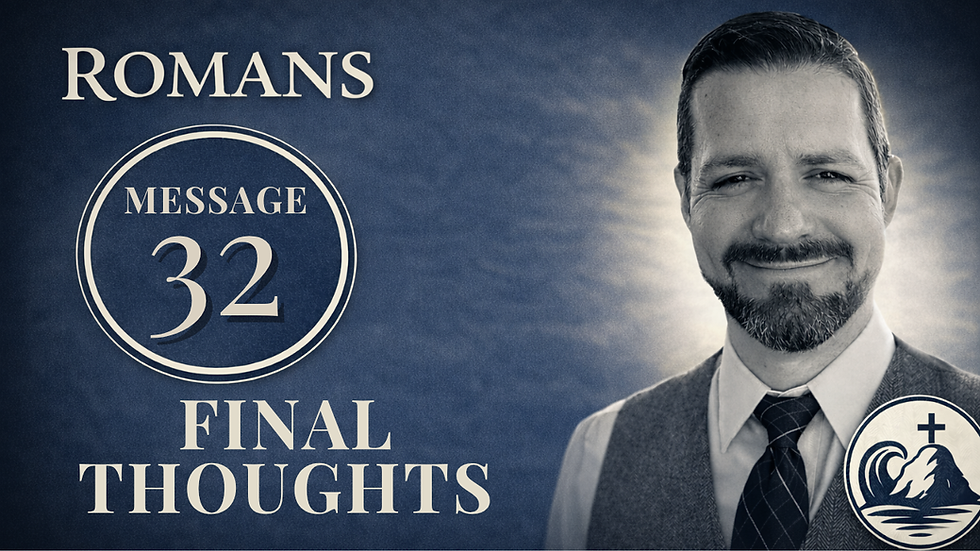
Hungry for the full study? This post is a summary of the final message in our 32-part series on the Book of Romans. To hear the full exposition of these verses and dive deeper into the riches of God's Word, we invite you to watch the full sermon by Elder Jonathan Moseley below.


Comments